


Most electric pot haulers don’t fail on a bad day. They fail after a slow stretch of small neglect: a green connection nobody checked, a roller groove worn smooth, a mount that loosened a little each trip. The fix isn’t complicated. It’s a schedule you can follow without thinking about it.
Here’s how often to service an electric pot hauler, what to check at each stage, and how the answer changes between a weekend crabber and a working boat.
Short answer: Rinse your hauler with fresh water after every trip. Inspect the roller, pins, mount, and electrical connections monthly, or every 10 to 15 heavy-use trips as a practical rule of thumb. Do a full check before each season and a deeper service with storage prep at season’s end. Commercial use calls for shorter intervals. Always follow your model’s own instructions first.
Why a Schedule Beats Waiting for Something to Fail
A pot hauler works in the harshest conditions a machine can face: salt spray, constant vibration, heavy current, and sun. Each one wears on a different part. Salt attacks connections. Vibration loosens fasteners. Load wears rollers and sleeves. Sun breaks down plastic and rope.
The difficult part is that these problems rarely announce themselves. A corroded connection still works, until the day it’s hot enough to trip the breaker. A schedule catches the small stuff while it’s still cheap.
After Every Trip: Rinse and Reset (5 Minutes)
This is the single habit that adds the most life to your gear.
- Rinse with fresh water. Hit the motor housing, roller, davit, pins, and plug. Use a gentle flow, not a pressure washer aimed at seams or electrical openings.
- Unplug and cap the socket. Don’t leave an open receptacle to take spray and rain.
- Rinse the line, and let it dry before you coil it.
- Look it over. A quick glance for loose pins, new play in the arm, or anything that looks different from last time.
- Stow out of the sun if the unit comes off the boat, since extended UV exposure is hard on plastic and rope.
Monthly, or Every 10 to 15 Heavy-Use Trips: A Real Inspection (15 Minutes)
The interval here is a rule of thumb, not a manufacturer spec. If you pull often, lean toward the shorter side.
Roller and line path. Look at the roller groove for wear. A groove worn smooth lets line slip and adds heat. Check that it spins freely.
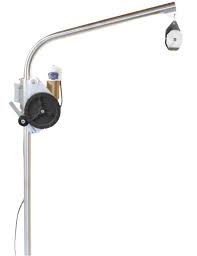
Pins and sleeve. Pull the pins, and look for wear or bending. Check the arm in its mount for side-to-side play. A little new play usually means a worn sleeve, and sleeves are cheap compared to replacing a whole mount. Our davit mounts are built with sleeves for this reason.
Mount and fasteners. Check that every bolt is tight and nothing has loosened from vibration. Look under the gunnel for movement or cracking around the base.
Wiring and connections. Look for chafed insulation, loose terminals, and any green or white powder. Feel the plug or connector after a run. Warm is normal. Hot is not.
Switch and breaker. Cycle the switch and confirm it works cleanly.
Battery terminals. Check that they’re clean and tight.
Before Each Season: The Full Check (1 to 2 Hours)
Treat the start of the season like a pre-flight inspection.
- Clean the electrical connections. With power off, remove the wire from the terminal or connector and clean both surfaces. BoatUS recommends turning off the master switch, removing the wire from the stud, and cleaning both before corrosion gets the best of the connection.
- Protect them. After cleaning, a light coat of dielectric grease helps keep moisture out. Practical Sailor notes that dielectric grease is acceptable for most electrical connections. Check your connector maker’s guidance before applying grease to a sealing surface.
- Inspect the wire run end to end. Look for chafe, kinks, and softened insulation.
- Test the battery. Confirm it’s charged and holds voltage under load.
- Test the fuse or breaker, and confirm the rating still matches your wire and puller.
- Replace worn parts. Swap any worn roller, sleeve, or pin now, not mid-trip. Browse our replacement parts and accessories.
- Run it at the dock. Do a light-load test before you trust it offshore.
If the breaker trips during your test, work through why your electric puller keeps tripping the breaker before you change anything else.
End of Season: Deeper Service and Storage
When the season ends, it’s tempting to throw the hauler in a corner. A little work now saves you from a bad surprise next spring.
- Rinse thoroughly and let everything dry completely.
- Clean and grease connections as above.
- Inspect for wear you were too busy to deal with mid-season, and order parts now.
- Remove the unit from the boat if it’s removable, and store it indoors, dry, and out of the sun.
- Cap the socket and cover exposed plugs.
- Charge the battery and keep it on a maintainer if it sits for months.
- Coil and store the line away from sun and moisture.
How Intervals Change by Use
| Weekend / recreational | Heavy commercial | |
|---|---|---|
| Rinse | After every trip | After every trip |
| Quick inspection | Monthly or every 10 to 15 trips | Weekly |
| Full check | Before the season | Before the season, plus mid-season |
| Parts on hand | A spare roller and pins | Spare roller, sleeve, connectors, fuses |
Commercial boats should also keep an eye on duty cycle. A hauler working hard every day shows wear faster than one used on weekends.
Signs Service Is Overdue
- Pulls are slower than they used to be
- The plug or connector runs hot
- The breaker trips more often
- The arm has new play or the mount wobbles
- The line slips or squeals on the roller
- You see green or white corrosion on any connection
- The motor makes new grinding or rattling noises
Any one of these is a reason to stop and inspect before the next trip.
Keep Spares Aboard
A short list prevents most lost days: a replacement roller, a spare sleeve and pins, extra fuses or a spare breaker, a few sealed connectors, and a small tube of dielectric grease. Our electrical accessories include a 12VDC 50-amp on/off switch made for EZ Puller models if yours needs replacing.
FAQs
How often should I service an electric pot hauler?
Rinse after every trip, inspect monthly or every 10 to 15 heavy-use trips, and do a full check before each season and a deeper service at season’s end.
Do I need to grease anything?
Dielectric grease on electrical connections helps keep moisture out. For moving parts, follow your model’s instructions.
Can I use a pressure washer?
It’s better to rinse gently. High pressure can force water past seals and into electrical openings.
What wears out first?
Rollers, sleeves, and electrical connections, especially around salt water.
Should I remove the hauler in the off-season?
If it’s removable, store it indoors, dry, and out of the sun.
How do I know if my battery is the problem?
Weak or slow pulls, a breaker that trips under load, or voltage that drops quickly point to a tired battery.
Questions About Your Model?
Every hauler has its own details, from wire size to wear parts. Contact our team with your model and how you fish, and we’ll point you to the right maintenance steps and parts. We’ve built electric haulers in the USA for nearly 35 years, and we’d rather help you keep yours running than see it fail mid-season.